Showing the Spirit by D. A. Carson
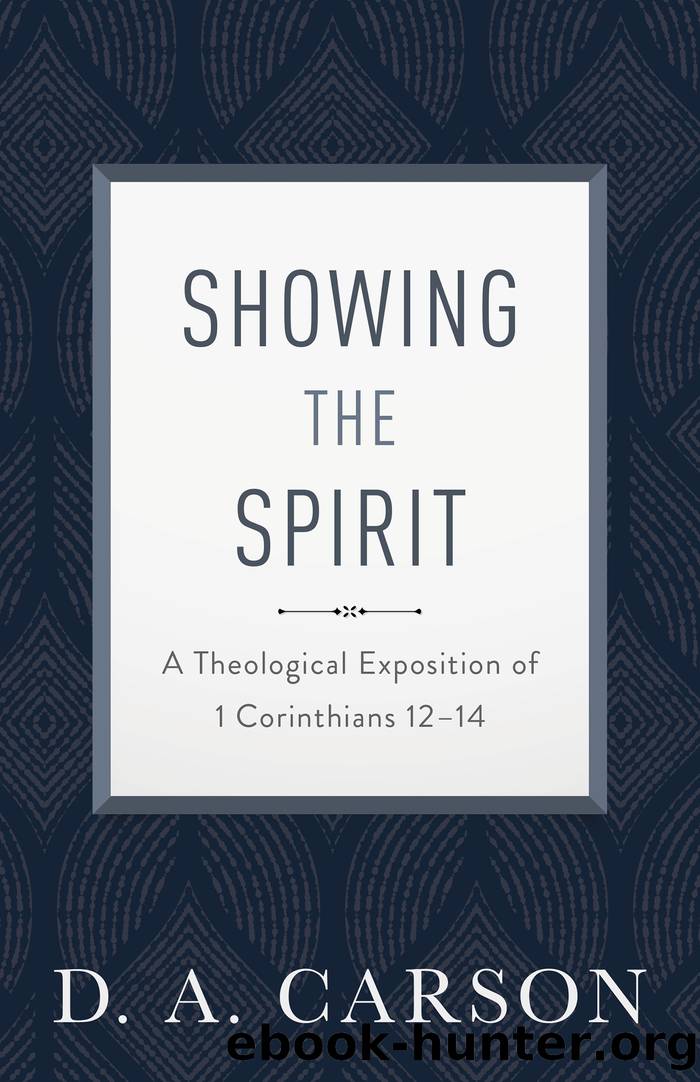
Author:D. A. Carson
Language: eng
Format: epub
Tags: Biblical Studies;Bible (NT First Corinthians 12—14)—Criticism | interpretation | etc.;Spiritual Gifts—Biblical teaching;REL006220;REL006720
ISBN: 9781493420414
Publisher: Baker Publishing Group
Published: 2018-11-19T00:00:00+00:00
Warning (14:37–38)
Part of the answer to the questions in the preceding verse (36) must be something like: No, we admit that the word of God first came to us through you; you first preached it to us.57 Verse 37 then follows naturally with a focus on apostolic authority, but this is so elevated that it stands a quantum leap above that of the prophets at Corinth. Indeed, Paul can actually make the acceptance of the authority of what he writes a necessary criterion of the validity of all claims to spiritual giftedness, including prophecy.
Several observations on the text will help to clarify the thrust of Paul’s claim.
First, the words rendered “what I am writing to you” are a translation of a plural expression, “the matters about which I am writing to you” or the like. This strongly suggests that Paul has in mind not the single injunction dealing with the silence of women, but everything he has said in this epistle58—and principally, beyond. But even if one were to decide that the relative pronoun has exclusive reference to chapters 12–14, it is hard to imagine that Paul himself understood chapters 1–11 to be less authoritative.
Second, the textual variant—whether we should render it “is of the Lord” or “is the Lord’s command”—has little bearing on the authority claim Paul is making. The latter is marginally more likely; but that means the use of “command” (ἐντολή, entolē) is a little different from that in 1 Corinthians 7, where “the Lord’s command” refers to what Jesus taught in the days of his flesh. Paul is not making that claim here: he simply means that what he has been writing is backed by the authority of the risen Christ himself. This shows that “the Lord’s command” was not a stereotyped expression, but could vary in force according to context.
Third, the word Lord is placed in an emphatic position. Paul is therefore associating submission to what he writes with submission to the Lord. Not to submit to what the apostle writes is thus to deny the lordship of Jesus, which is the Christian’s central confession as stipulated at the beginning of these three chapters (12:3). It is hard to resist seeing an inclusio (a figure of speech in which everything in these three chapters, sandwiched between two strong references to the lordship of Jesus, must be read in the light of that lordship). As we shall see in a moment, there are other hints that Paul is harking back to 12:1–3 and drawing his argument to a close.59
Fourth, that Paul’s authority should be placed so decisively above that of the prophets has obvious bearing on our understanding of prophecy in Corinth. Paul clearly believes that prophecy is revelatory (see v. 30); equally clearly, he does not conclude on this ground that the authority of the prophets is therefore absolute. Rather, he holds that, principally, the prophetic word “must at every point agree with the apostolic deposit or it is to be rejected.”60 I shall try
Download
This site does not store any files on its server. We only index and link to content provided by other sites. Please contact the content providers to delete copyright contents if any and email us, we'll remove relevant links or contents immediately.
The Lost Art of Listening by Michael P. Nichols(7509)
Why I Am Not A Calvinist by Dr. Peter S. Ruckman(4157)
The Rosicrucians by Christopher McIntosh(3523)
Wicca: a guide for the solitary practitioner by Scott Cunningham(3182)
Signature in the Cell: DNA and the Evidence for Intelligent Design by Stephen C. Meyer(3141)
Real Sex by Lauren F. Winner(3026)
The Holy Spirit by Billy Graham(2957)
To Light a Sacred Flame by Silver RavenWolf(2828)
The End of Faith by Sam Harris(2747)
The Gnostic Gospels by Pagels Elaine(2537)
Waking Up by Sam Harris(2464)
Nine Parts of Desire by Geraldine Brooks(2375)
Jesus by Paul Johnson(2366)
Devil, The by Almond Philip C(2338)
The God delusion by Richard Dawkins(2314)
Heavens on Earth by Michael Shermer(2286)
Kundalini by Gopi Krishna(2188)
Chosen by God by R. C. Sproul(2166)
The Nature of Consciousness by Rupert Spira(2110)
